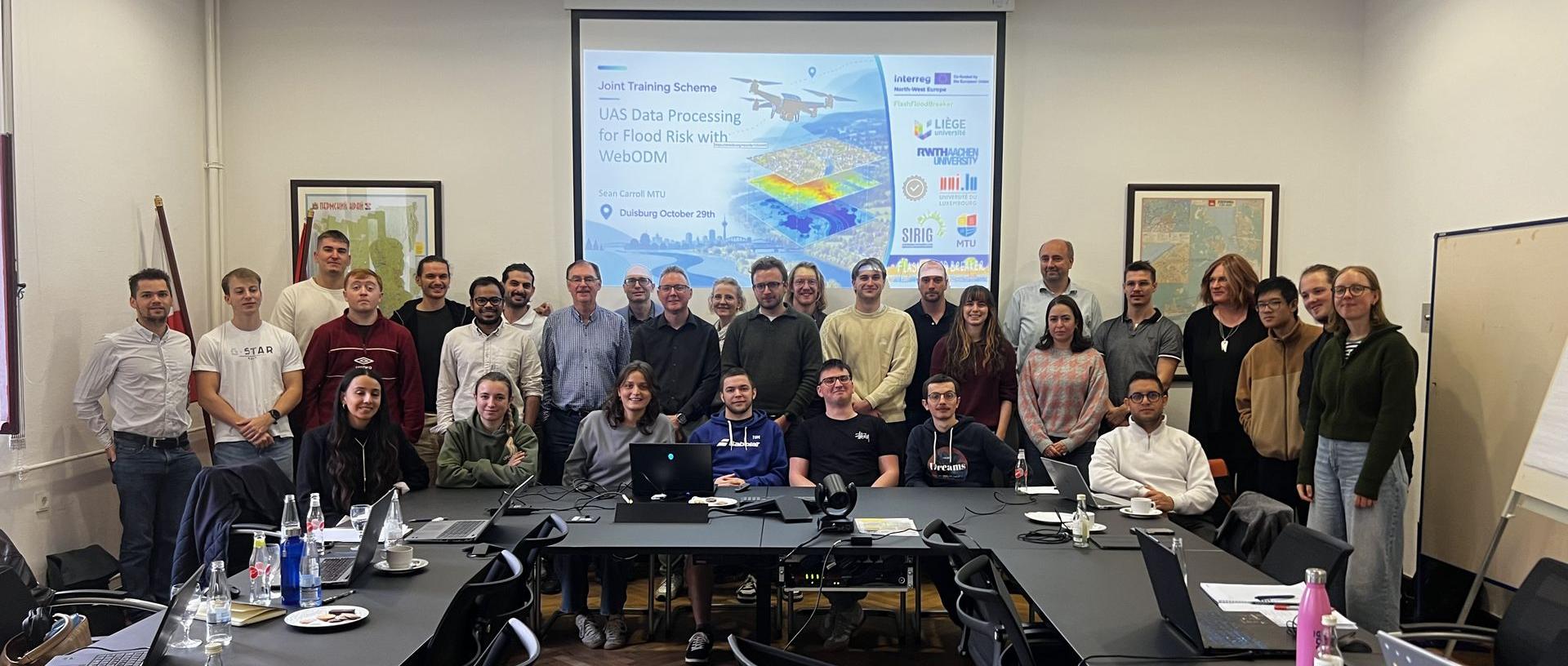
On 29 and 30 October 2026, FlashFloodBreaker brought students and young, early-career professionals to Duisburg for a two-day Training Event on Flash Flood Emergency Response. The participants came from the academic branch of our partnership_ four European universities: Munster Technological University (MTU), the University of Liège, the University of Luxembourg and RWTH Aachen University.
They brought backgrounds in civil and water engineering and the sciences. The training covered the whole spectrum of flood risk management. It went from understanding flood risks to modelling them, and from planning flood protection to responding when it matters most.
Step 1: Preparing online
From early October, participants worked through training videos online. They covered flash flood risk, drone applications and flood modelling, so everyone arrived in Duisburg with a shared foundation.
Day 1: In the classroom at Duisburg City Hall
The first day, hosted by the City of Duisburg, was about understanding flash floods before fighting them. After an introduction by Dr Joe Harrington (MTU), researchers from the University of Liège looked at how flash floods develop.
They traced the risk chain from extreme rainfall to actual damage. They showed how land use, slope, soil moisture and the intensity of a storm decide whether heavy rain becomes a disaster. And they explained why flash floods need different management than ordinary river floods. Real cases illustrated each point, along with the options for protection, from permanent structures to temporary and mobile barriers.
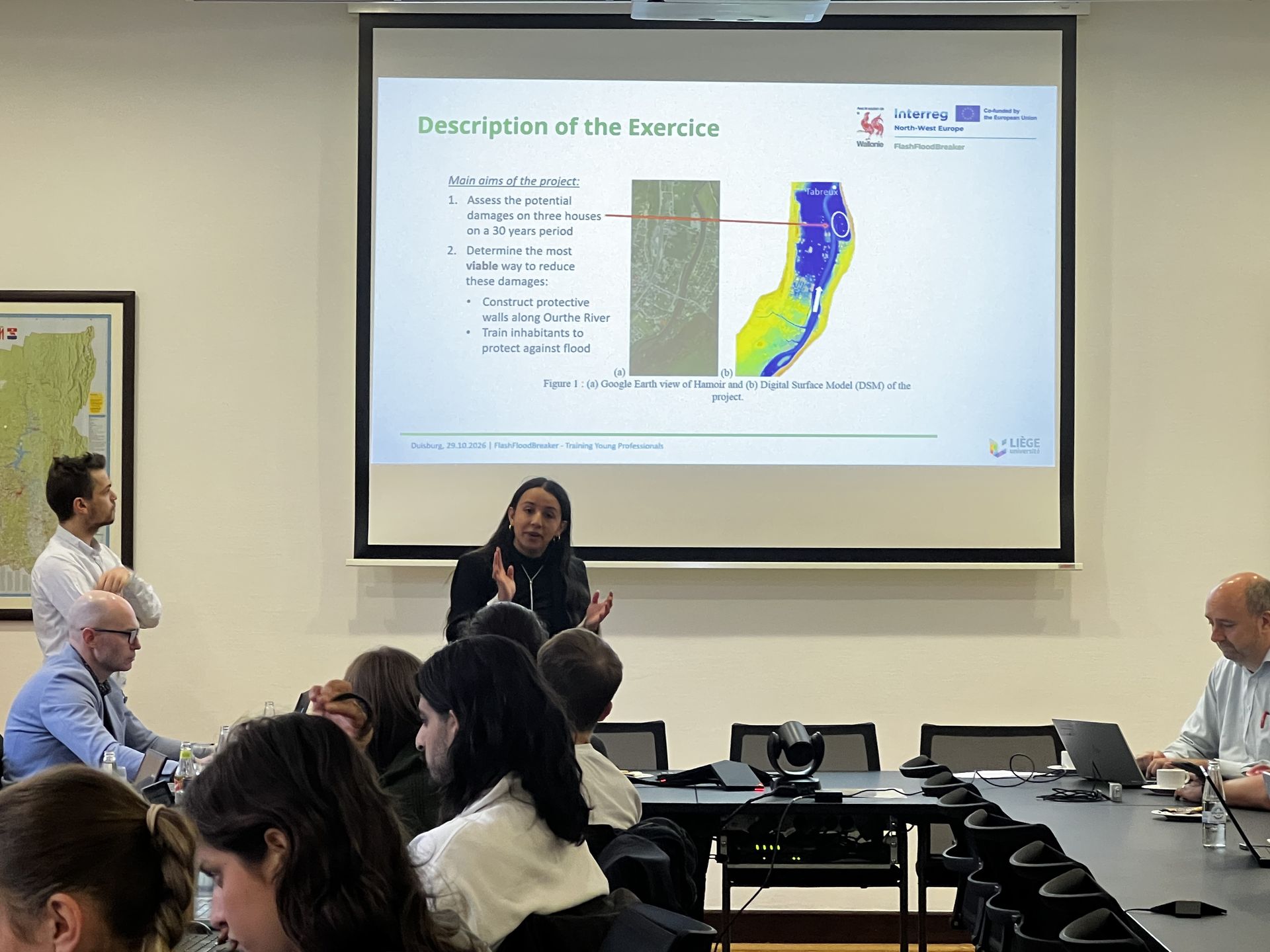
Maria Paula Avila and Alexandre De Becker (University of Liège) explained the different types of inland floods, introducing the risk chain from extreme rainfall to actual damage
The focus then shifted to new technologies. Trainers from MTU and the University of Luxembourg showed how drones can support crisis management:
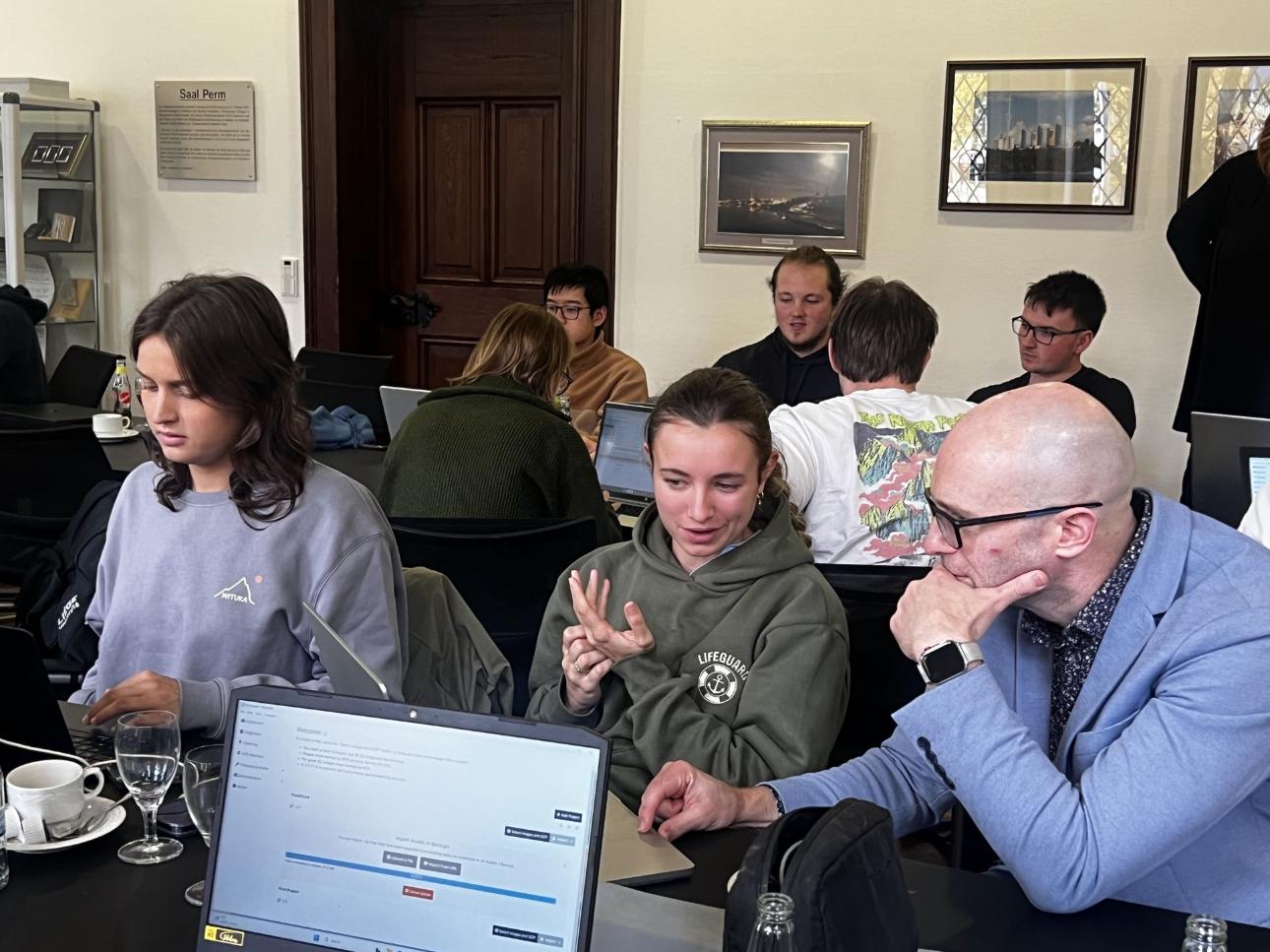
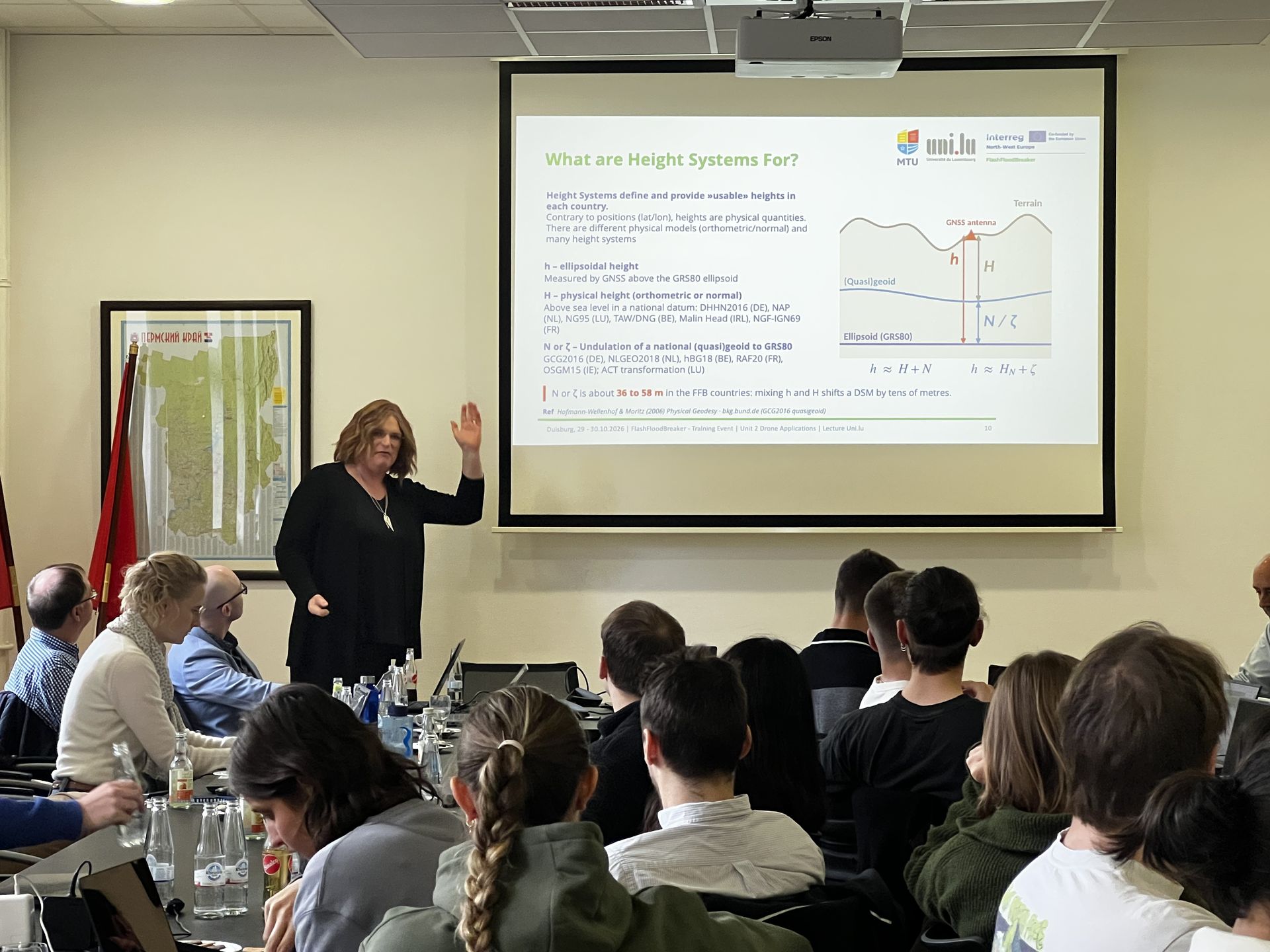
Sean Carroll (MTU) and R. Teferle (University of Luxembourg) talking about Safe drone operations under EU regulations, capturing field data and processing images into maps for flood risk assessment.
In the afternoon, participants worked on the modelling tools that FlashFloodBreaker is piloting at catchment scale. MTU introduced hydrologic models and AI methods that automatically detect flooded areas and damage in drone images. RWTH Aachen covered hydraulic modelling, which simulates how water spreads across a landscape. Taken together, the day showed how digital data, models and artificial intelligence can help decision-makers see a flood coming and respond in time.
Day 2: Hands-on at the training levee of Feuerwehr Duisburg
On the second day, the training moved from the lecture room to the levee. At the full-scale training levee of the Duisburg Fire Department, participants worked alongside emergency responders. The exercise was led by Christian von Spiczak and Feuerwehr Duisburg. It was made possible together with Emschergenossenschaft/Lippeverband (EGLV), represented by Jörg Reinecke, and the local THW unit (THW Ortsverband Duisburg). Participants went through seven practical stations, and the video above shows how it went.
Stronger together, across borders
What made the training special was its mix of scientific knowledge, interdisciplinary exchange and practical experience. Students and young professionals from different universities, countries and disciplines learned from each other, compared perspectives and built connections across the European flood risk management community.